Why Learning Spanish Is More About Confidence Than Vocabulary

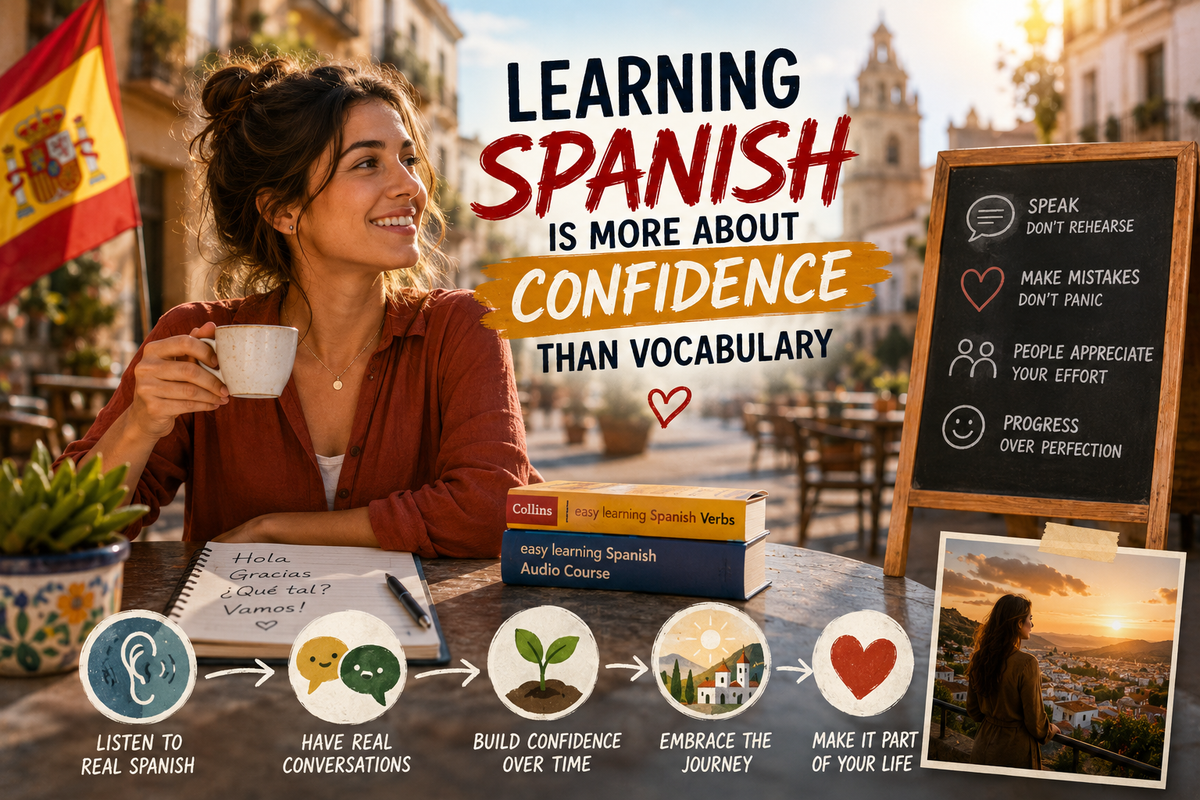
When I first moved to Spain, I thought learning Spanish would be a straightforward process: study vocabulary, memorise grammar, practise speaking, repeat. But it didn’t take long to realise that fluency isn’t a language milestone - it’s a mindset.
Spanish didn’t become easier when I learned more words. It became easier when I stopped being afraid of using the ones I already knew.
Here’s why confidence matters more than vocabulary, and what actually makes the difference when you’re learning to speak another language.
🧩 Fluency Isn’t About Knowing Everything - It’s About Using What You Know
You can study Spanish for years and still freeze the moment someone speaks to you. You can also know a fraction of the vocabulary and hold a perfectly natural conversation.
The difference isn’t knowledge. It’s confidence.
Confidence lets you:
- speak without rehearsing
- make mistakes without panicking
- keep going even when you don’t understand every word
- trust that communication is more than accuracy
Spanish speakers don’t expect perfection. They expect effort.
And effort is something you can show long before you feel “ready.”
🎧 Accents, Regions, and Real‑World Spanish
One of the biggest shocks for anyone learning Spanish is realising there isn’t one Spanish. There are dozens.
Someone from the north of Spain sounds nothing like someone from the south of Spain. Someone from Colombia sounds nothing like someone from Mexico. Someone from Peru sounds nothing like someone from Venezuela.
At first, this feels overwhelming. Then you realise it’s actually freeing.
You don’t need to understand every accent. You just need to understand the ones around you and get comfortable asking people to repeat themselves.
If you want something to help you tune your ear, the Collins Easy Learning Spanish Audio Course is a great companion. It focuses on real spoken Spanish, not textbook Spanish, which makes a huge difference when you’re dealing with regional accents.
🗣️ The Real Barrier Isn’t Grammar - It’s Fear
Most people don’t struggle with Spanish because they don’t know enough. They struggle because they’re scared of:
- sounding stupid
- making mistakes
- being judged
- not understanding the reply
- freezing mid‑sentence
But here’s the truth: Spanish speakers don’t care if you make mistakes. They care that you’re trying.
Once you accept that mistakes are part of the process, everything becomes easier. You stop translating in your head. You stop overthinking. You stop treating every conversation like an exam.
You just speak.
📚 Vocabulary Helps - But Only If You Use It
There’s nothing wrong with learning new words. But vocabulary only becomes useful when it leaves the page and enters your mouth.
A simple tool like the Collins Easy Learning Spanish Verbs guide can help you understand how verbs actually work in real sentences. But the real progress happens when you start using those verbs in everyday conversations; even if you conjugate them wrong half the time.
Spanish rewards participation, not perfection.
🤝 Conversations Teach You More Than Any App
Apps are great. Books are helpful. Courses are useful.
But nothing replaces real conversations.
Talking to your barber, your neighbour, the person at the bakery, the waiter at your local café - these interactions teach you:
- natural phrasing
- real‑world speed
- cultural context
- body language
- when to speak formally vs casually
And most importantly: they teach you how to stay calm when you don’t understand something.
Confidence grows through exposure, not isolation.
🧠 Your Brain Learns Faster When You Relax
The more pressure you put on yourself, the harder Spanish becomes. When you relax, your brain actually absorbs more.
That’s why some of your best Spanish moments happen:
- after a long walk
- when you’re tired
- when you’re not trying
- when you’re just chatting casually
A calm mind learns faster.
🌱 Spanish Isn’t a Skill You Master: It’s a Space You Grow Into
Learning Spanish isn’t about reaching a finish line. It’s about becoming comfortable in a language that isn’t yours yet and slowly making it part of your life.
Confidence builds through:
- repetition
- exposure
- mistakes
- small wins
- showing up again tomorrow
And one day, without realising it, you’ll notice something shift. You’ll order food without thinking. You’ll understand a joke without translating it. You’ll speak without rehearsing.
That’s the moment Spanish stops being something you’re learning - and starts being something you live.